Poetry for Valentine's Day:
Two Poems After Dinner and a Sonnet to Revert Life
After taking a long break, I would like to retake my blog with three Valentine poems: Two of them written after a late dinner and a dawn breakfast, and one of them before having sweet dreams a third night. The first version of The Blueberry Moon was entitled The Blueberry Poem, which I wrote as the latter on a large napkin, ended up in the diner's trash, since a waitress took it away when I stepped out from my table for a minute. The napkin was never found! So this is the subsequent version of the second moon poem, the double moon.
The Blueberry Moon
The lost poem inspires the blue moon
tender, cloudy, nuanced by the silence night
rewritten wealth over every golden word of love.
Transcendental freedom, mystic love, magic dream
colorful flowers, white roses, blue honey melted
transparent in the dark, luminous at light.
The juicy moon, sweet like milk and honey
satisfies the inspired nude with perfect words
uncountable dream vigorously hit by wind
smooth, lightened night, gracious like the mind.
The moon melts like a blueberry French toast
unequal feelings, unexpected farewells, forgotten glory
candid... she is in the middle of the night
rewritten pleasure, glorious freedom, silent night.
Ganando sobre el tiempo
Escribiendo gano sobre el tiempo
que es el dueño de tus encantos
que me lleva como el viento
y me deja lleno de goce bajo el manto.
Encuentro el triunfo sin límites
quedándome frente a tu aliento
tu hálito tierno acaricia mis labios
voces de adentro traen mi sentimiento.
Las rubias danzan y entrengan todo
todo, todo... mas tu entera te llenas
y te afecta el sentimiento recodo
y no sabes si el alma misma te quema.
Ajeno al sentimiento me inspiro
con espíritu ferviente y casi reviento
voz que me llama como un lamento
recuerdo amargo por lo perdido.
My third poem has following poem has been dedicated privately, and unlike my natural poetry writing strategy it had was carefully adjusted until fitting into a sonnet format... quietly in my room.
Soneto para Revertir la Vida
A mis 20, un corazón dulce, immenso en ternura
esparce el camino sobre las olas en un lazo eterno
nuestros pies mojados con el barro de mi tierra
caricia de la brisa que nos une para siempre.
A los 20, vuelvo al lago inmenso donde soñaba
y despierto con el horizonte de mi mar, la mar...
callo en el silencio vano de los enamorados
y siento el cálido abrigo de tus manos de seda.
Me agrada el recuerdo de nuestro andar unidos
nuestro pasos mojados por la resaca y el barro
la sal de nuestro mar, nuestro cielo, y nuestras huellas.
Si lograra revirtir mis años, te amaría diferente
y sería el enamorado más amado
el joven olvidado, recordado por el tiempo

This blog is dedicated to introducing my writings, important literary analysis, and general literary events and articles.
Wednesday, February 3, 2010

Thursday, July 16, 2009
My Favorite Poets II: The Europeans

“On ne badine pas avec l’amour” Alfred de Musset
Prof. A was to recite Malherbe’s poetry “Consolation à M. Du Perrier”. Except for Franklin’s “The Cock”, it was the first time I actually study a poem beyond a Catholic celebration at my primary’s school or special day like mother’s day.
Like Professor A., I developed a personal admiration for Malherbe’s journal poetic style: He felt in fact like a troubadour. Likewise, we both admired Rainer Maria Rilke, not just because of Professor A’s admiration itself, but because I consistently identified personal life events with those of Rilke’s life, in particular. Yes, Indeed, like most Americans and Latin-Americans, I do admire Shakespeare, although I have never made a systematic study of his admirable work.
My most involved study of any European literature took place just before passing my second Sorbonne exam around 1985, and consistently by reading several historic studies of French Literature, in particular, that by M., Pierre de Boisdesffre, the ancient Colombian Ambassador, whom I happen to meet personally during a party at the Alliance Française. In spite of different ideologies, his book is objective and well elaborated, and does entice the study of French poetry, as well. There were several other books by the same title that I read, but being in touch with such a cultivated author was inspiring after all.
I have selected some inspiring verses that convey fun, love, romance, melancholy, nostalgy, and many other poetic feelings and flavors.
As Rilke is not Goethe for the Germans, Rilke’s poetry has many poetic lovers worldwide. Here. I rescued the following verses:
Ich liebe meinses Wesens Dunkelstunden
in welchen meine Sinne sich vertiefen;
in inhen hab ich, wie in alten Briefen
mein Täglich Leben schon gelebt gefundend
und wie legende weit und uberwunden.
Aus inhen kommt mir Wiseen, dass ich Raum
zu einem zweiten Zeitlos breiten Leben habe,
Un manchmal bin ich wie der Baum,
der, reIf und rauschend, über eineM Grabe
den Traum erfüllt, den der vergangne Knabe
(um den sich seine warmen Wurzeln drängen)
verlor in Traurigkeinten und Gesängen.
I love these verses, whose English version reads:
I love the dark hours of my being
In which my senses drop into the deep
I have found in them, as in old letters,
My private life, that is already lived through
And become wide and peaceful now like legends
Then I know that there is room in me
For a second huge and timeless life.
But sometimes I am like that tree that stands
Over a grave, a leafy one, fully grown
Who has lived out that particular dream
That the dead boy
(around whom its warm roots are pressing)
Lost through his sad moods and his poems.
Rilke has written Requiem, In The Hours of Prayer for a special type of poetry genre driven by the German key work Innigkeit.
Reading Shakespeare’s Sonnets in an accelerating experience that goes
beyond Hamlet or Juliet and Romeo. I read:
Those hours with gentle work did frame
the lovely gaze where every eye doth dwell
will play the tyrants to the very same
An that unfair which fairly excel.
And I also read the sharp hearted message:
Against that time, if ever that time come,
When I shall see the frown of my defects,
Whereas thy love casts its utmost sum,
Called to that audit by advised respects
And let us recall the French, from whom I encounter Baudelaire, Hugo, and Musset three of the greatest:
Let us read from Paul Verlaine’s Poèmes Saturniens, Mon rêve familier:
Je fais souvent ce rêve étrange et pénétrant
D’une femme inconnue et que j’aime, et qui m’aime;
Et qui n’est, chaque fois, ni tout à fait la meme
Ni tout à fait une autre, et m’aime et me comprend.
And also from Verlaine is Le Ciel est par-dessus le toit:
Le ciel est, par-dessus le toit,
Si bleu si calme!
Un arbre,par-dessus le toit,
Berce sa palme
My literary study on François Villon, Le Testement, includes Ballade des dames du temps jadis, as follows:
Dites-moi où, n’en quell pays,
Est flora la belle Romaine,
Archipiades, ne Thaïs,
Qui fut sa cousine germaine,
Écho, parlant quand bruyt on mène
Dessus rivière ou sur étang,
Qui beauté eut trop plus qu’humaine?
Mais où sont les neiges d’antan?
…
And from Apollinaire’ Alcools;
Je passé au bord de la Seine
Un livre ancient sous le bras
Le fleuve est pareil à ma peine
Il s’écoule et ne tarit pas
Quand donc finira la semaine
Besides, I have also read, from Verlaine’s 1874 Romances sans parole, Il pleure dans mon Coeur:
Il pleure dans mon Coeur
Comme il pleut sur la ville;
Quelle est cette langueur
Quit pénètre mon Coeur.
On the day when I received my diploma from University of Paris-Sorbonne, I received a book the celebrated enfin de vingt ans, Alfred de Musset, from whom I quote an excerpt of his Chanson de Fortunio:
Si vous croyez que je vais dire
Qui j’ose aimer
Je ne samurais, pour un empire,
Vous la nommer.
…
Du mail qu’une amour ignore
Nous fait soufrir,
J’emporte l’âme déchirée
Jusqu’à mourir.
Also from Musset, I have read Ballade à la Lune:
C’était, dans la nuit brune
Sur le clocher jauni
La lune
Comme un point sur un i.
…
And from Pierre de Ronsard, I read his Continuation des Amour (1555), Sonnet à Marie:
Je vous envoie un bouquet que ma main
Vient de trier de ces fleures épanies;
Qui ne les eût à ce vêpre ceuillies,
Chutes à terre ells fussent demain.
And from my extensive reading of Baudelaire’s Les Fleurs du Mals, which received a welcome bilingual critique by various international newspapers last year:
Je t’adore àl’égal de la voûte nocturne,
Ô vase de tristesse, ô grande nocturne,
Et t’aime d’autant plus, belle, qu etu me fuis,
Et que tu me parais, ornament de mes nuits,
plus ironiquement acumuler les lieus.
Qui séparent mes bras des immensités bleues.
Je m’avance à l’attaque, et je grimpe aux assaults,
Comme après un cadaver au chœur de vermisseaux,
Et je chéris, ô bête implacable et cruelle!
Jusqu’à cette froideur par où tu m’es plus belle.
Oh!, Verlaine who sings his poetry from La Bonne Chanson (1870) with La Lune Blanche:
La lune blanche
Lui dans les bois
Du chaque branche
Par une boix
Sous la ramée
Ô bien-aimée.
L’etang reflète
Profound miroir,
La silhouette
Dan saule noir
Où le vent pleure
Rêvons, c’est l’heure.
Un vaste et tendre
Apaisement
Semble descendre
Du firmament
Que l’astre irisie
C’es l’heure exquise.
And from Mallarmé’s Sonnet:
Ôsi chère de loin et proche et blanche, si
Délicieusement toi, Méry, que je songe
À George d’Scudery, Poésies Diverses (1661), I read:
Vous faites trop de bruit, Zéphire, taisez-vous,
Pour ne pas éveiller la belle qui repose;
Ruisseau qui murumurez, évitez les cailloux,
Et si le vent se tait, faites la meme chose.
And from my reading of Paul Valery’s complete works (Charmes), Les Pas:
Tes pas, enfants de mon silence,
Saintement, lentement places,
Vers le lit de ma vigilance
Procèdent muets et glacés.
Personne pure, ombre divine
Qu’ils son doux, tes pas retenus!
Dieux!... tous les dons que je devine
Viennent à moi sur ces pieds nus!
Yet, I have read from Rimbaud in his poem Sensation:
Par les soirs bleus d’été, j’irai dans les sentries,
Picoté par les blés, fouler h’herbe menue:
Rêveur, j’en sentirai la fraîcheur à mes pieds,
Je laisserai le vent baigner ma tête nue.
And also from Rimbaud’s Poésies, I read:
Les parfums ne font pas frissonner sa narine;
Ils dort dans le soleil, la main sur sa poitrine
Tranquille. Il a deux trous rouges au côté droit.
Furthermore, I expanded my Francophone studies at the Alliance Française, with my readings of French African Léopold Sedar Senghor poetry, one of the outstanding black writers and poets. I read his Femme Noire:
Femme nue, femme noire
Vêtue de ta couleur qui est vie, de ta forme qui est beauté!
I certainly have to comment on Racine’s poem Excité d’un désir curieux:
…Excité d’un désir curieux,
Cette nuit je l’ai vue arriver en ces lieux,
Triste, levant au ciel ses yeux mouilés de larmes
Qui brillaient au travers des flambeaux et des armes,
Belle san ornament, dans le simple appareil
D’une beauté qu’on vient d’arracher au sommeil…
As I visited the Paris hotels that inspired Louis Aragon’s lovers inspired his poetry in the Quartier Latin, I recall having read Les yeux d’Elsa:
Tes yeux sont si profonds qu’en me penchant pour boire
J’ai vu tous les soleils y venir se mirer
S’y jeter à mourir tous les désespérés
Tes yeux sont si profonds que j’ys perds la mémoire.
And also from Aragon:
Il n’y a pas d’amour hereux
Rien n’est jamais acquis à l’homme ni sa force
Ni sa faiblesse ni son Coeur et quand it croît
Ouvrir ses bras son ombre est celle d’une croix
Et quand it croit serer son bonneur il le broie
Sa vie est un étrange et douloureux divorce
Il n’y a pas d’amour heureux.
And From Rostand’s, je t’aime, je suis fou...:
Je t’aime, je suis fou, je n’en peux plus, c’est trop;
Ton nom est dan mon Coeur comme dans un grelot,
…
Baudelaire’s particularly dark, sometimes sordid, sometimes mystic and nuance with a romantic or scatological content sometimes inspired me with the fear that it was against my own spiritual beliefs. These is an excerpt from La Mort des amants:
…
Un soir fait de rose et de bleu mystique,
nous échangerons un éclair unique,
comme un long sanglot, tout chargé d’adieux;
…
Also from Baudelaire’s Recueuillement:
…
Pendant que des mortels la multitude vile,
Sous le fouet du Plaisir, ce bourreau sans merci,
va ceuillir des remord dans la fête servile,
ma douleur, donne-moi la main; viens par ici.
…
The 16th Century poetry saw Malherbe’s Oeuvres succeed, driven by events that inspired the poet:
From Malherbe’s Consolation à Monsieur Du Périer, this is an example over the loss of M. Du Perrier’s daughter Rosette, erroneously referred by his printer as “rose”.
Ta douleur, Du Périer, sera donc éternelle,
et les tristes discours
Que te met en l’esprit l’amitié paternelle
l’augmenteront toujours?
While Victor Hugo made romanticism shines, it did not neglect the humorous approach in Jeanne était au pain sec in his 1877 L’art d’être grand-père…:
Jeanne était au pain sec dans le cabinet noir,
Pour un crime quelqonque et, manquant au devoir,
J’allai voir la proscrite en pleine forfeiture,
Et lui glissai dans l’ombre un pot de confiture,
Contraire aux lois. Tous ceux sur qui, dans ma cite,
Repose le salut de la societé,
…
As melancholic as a poet could reach, Guillaume Apollinaire writes his Le Pont Mirabeau:
Sous le pont Mirabeau coule la Seine
Et nos amours
Faut-il qu’il m’en souvienne
La joie venait toujours après la peine
Vienne la nuit sonne l’heure
Les jours s’en vont je demeure.
…
La Brise Marine is an interesting poem from Stéphane Mallarmé from his Poésies (1887), which drives son of my early seashore experiences:
La chair est triste, hélas! et j’ai lu tous les livres.
Fuir! Là-bas fuir! Je sens que des oiseaux sont livres
D’être parmis l’écume inconnue et les cieux!
Rien, ni les vieux jardins réfletés par les yeux
Ne tiendra ce Coeur qui dans la mer se trempe
…
Nostalgic feelings are also expressed by Alphonse de Lamartine in his Méditations Poétiques, I encountered Le Lac:
Ainsi toujours poussés vers de nouveux rivages,
Dans la nuit éternelle emportés sans retour,
Ne pourrons-nous jamais sur l’océan des ages
Jeter l’ancre un seul jour?
…
And from Boileau, his Art Poétique, and Épîtres, and his great influence from his influence from Malherbe. Boileau’s poetic art is compared creatively to Racine’s theatrical writings, in particular for his work Phèdre. I read from Boileau’s Art Poétique:
…
Chez nos dévots aïeux le théâtre abhorré
Fut longtemps dans la France un plasir ignoré.
De Pèlerins, dit-on, une trouple grossière
En public à Paris y monta la première;
…
There are many other great Europen poets like George Sand, Dante, Petrarca and many others not included in this writing, yet they still reveal their poetic spirituality and the links to life: mystic realities, dogmas and a variety of poetic approaches to real life and fantasy.
As a reminder for the reader, this blog does not condone any of the literary or philosophic views of any writer or poet. It is not necessary a literary analysis or comparative literature approach, but simply a way to have fun reading, recalling my readings and previous literary studies. It should serve as a source of reference delirium to any reader in any manner, and thus any comments made should never offensive or insulting to anyone, since they usually come from a fact, and further studies involving other experts as well.
Next:
- Camus and Sartre and how I passed my Sorbonne exam.
Thursday, July 3, 2008
Reviving the History of my Short Stories (II)

Susana is perhaps the prettiest woman I have seen, and the most beautiful character I ever created or described. This is the winning short story of the 1983 Metropolitan University (Barranquilla, Colombia), and the only one of my short story actually published in a book, by Universidad Metropolitana Editions. Please note that Diario del Caribe had decided to spanishize my name and printed it as Antonio rather than Anthony, a significant recommendation from friends and several members of La Esquina literary group, quite linked to El Caribe newspaper, where I once also worked as a part-time IT consultant.
 3
3

***
 1
1
 2
2
 3
3
 4
4
 5
5
 6
6


 1
1
 2
2
 3
3

Susana is perhaps the prettiest woman I have seen, and the most beautiful character I ever created or described. This is the winning short story of the 1983 Metropolitan University (Barranquilla, Colombia), and the only one of my short story actually published in a book, by Universidad Metropolitana Editions. Please note that Diario del Caribe had decided to spanishize my name and printed it as Antonio rather than Anthony, a significant recommendation from friends and several members of La Esquina literary group, quite linked to El Caribe newspaper, where I once also worked as a part-time IT consultant.
The epigraph atop the short story reads “Men of cold character have quick eyes”, Nathaniel Hawthorne, (Journals, 1937) 1
1 2
2
 1
1 2
2 3
3
***
The French version of “No me Sigas, María” (“Don’t follow me, María”) translated under the title of “Ne viens pas, Marie” (“Don’t Come, María”). The translation was a joint effort of great friends like French-Italian Professor Elizabeth Lamboglia, Prof. Eric Séebold, then Director of the Alliance Française, and myself for some contents and expressions. This can get diverse opinions from a few European Francophones and Canadian readers of this blog.
 1
1 2
2 3
3 4
4 5
5 6
6
7
***
An excerpt of my column appearing in El Heraldo newspaper that I wrote in Cali after receiving a National Literary prize. My column appears next to that of German Vargas, a well-know critical writer in García Márquez literary movement.
The number of my American Spanish short stories is just about 12. Some have survived time. This is one that in the first few years after my arrival in North America. This simple short story clear shows how difficult was it to recreate a Latin American scenary immersed in an American environment, where the Spanish language struggles to be a pure language with some American regionalisms, Caribbean barbarisms, while being greatly impacted by Spanglish more than just plain Angliscims. Most versions of the Spanish (Castellano) spoken in Latin American combine a good spoken and written language, with a great variety of regionalist slangs, and some barbarisms. Unlike many native Colombian writers, I do not curse in any of my writings, in great part for the negative feedback by my critics as a teen writer, the pressure from my school teachers, like Prof. R. Díaz, but by far my French literature teachers, who explicitly asked me to avoid this in order to maintain a global literary and creative level, and seek to a be an elite writer. Likewise, I limited the number of regionalisms I ever used due to the same factor.
 1
1 2
2 3
3Friday, June 20, 2008
Recounting the History of my Short Stories
I started my short story writing career after I read a Selected Reading short story entitled “El Pequeño Escribiente Florentino” (The Little Florentinian Writer). I had consistently published my short stories in the weekly billboard at the Instituto Alexander Von Humboldt, that I managed with the assistance of a few Grupo Progresista ("El GP") supporters, which I had founded in an effort to attain further leadership in the classroom. We had been encouraged by the “to be more” philosophy rather than the “to have more” philosophy, by our leading teacher Carmelo de La Ossa. Literarily, I had created a strong male character, Hermenegildo, inspired by a picture of my grandfather whom I did not know, and whom I only met after my twenty-third birthday. Likewise, I had created María, a coquette female character partly inspired by some of my classmates by that name, who were somewhat playful with me at times, and with whom I had a great deal of fun. Possibly, María also had to do with my very beautiful girlfriend at that time, Carmen. They were so well elaborated after a few years that I won several literary prizes based on more complex related short stories.
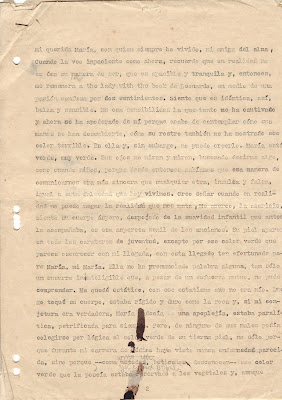
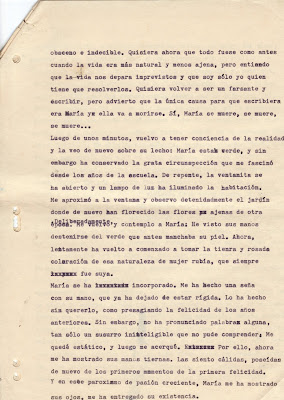
“The Blue Eyes of My Green María” (below), published on my weekly Humboldt outdoors billboard, is the short story that initiated it all for that character.
 1
1
 2
2
 3
3
 4
4
 5
5
 At age 15, I got my first literary prize and my first regional newspaper publication with Diario del Caribe, a subsidiary of El Tiempo..
 1
1
 2
2
El Retrato del Fantasma, my book title, and also my first university literary prize, while a student at Universidad del Norte, and published by the University magazine "Huellas". It was also published by the regional newspaper Diario del Caribe.
 At 19: El Espectador's Magazin Dominical issue #32 publishes my winning short story "Do not follow me, María" at University of Cartagena National University Short Story Contest.
 1
1
 2
2
 3
3
 At age 20: The cover portion of the winning short story "Ese Obsceno Personaje Llamado Maria".
German Vargas, a member of Noble Prize winner García Márquez’s literary and artistic group wrote in his then popular critical column in El Heraldo: “The fact that the jury has selected Noriega-Carranza’s short story deserves to be pointed out.” I believe this is because I had surpassed a few senior writers in the genre and won the contest both for its content and its writing style.
 A portion of the winning short story "Ese Obsceno Personaje Llamado Maria"
 Universidad del Valle communicating the winning prize (letter)
 Universidad de Cartagena Communicating the winning prize (letter)
 Universidad de Cartagena Communicating the winning prize (envelope)
 My picture at age 20 after winning the national short story sponsored by Universidad del Valle, Cali, Colombia. The picture was taken at Diario del Caribe (Barranquilla, Colombia) possibly during a break, where I also worked as a part-time consultant, progamming in the Basic language to control the newspaper page production operations.
I started my short story writing career after I read a Selected Reading short story entitled “El Pequeño Escribiente Florentino” (The Little Florentinian Writer). I had consistently published my short stories in the weekly billboard at the Instituto Alexander Von Humboldt, that I managed with the assistance of a few Grupo Progresista ("El GP") supporters, which I had founded in an effort to attain further leadership in the classroom. We had been encouraged by the “to be more” philosophy rather than the “to have more” philosophy, by our leading teacher Carmelo de La Ossa. Literarily, I had created a strong male character, Hermenegildo, inspired by a picture of my grandfather whom I did not know, and whom I only met after my twenty-third birthday. Likewise, I had created María, a coquette female character partly inspired by some of my classmates by that name, who were somewhat playful with me at times, and with whom I had a great deal of fun. Possibly, María also had to do with my very beautiful girlfriend at that time, Carmen. They were so well elaborated after a few years that I won several literary prizes based on more complex related short stories.
“The Blue Eyes of My Green María” (below), published on my weekly Humboldt outdoors billboard, is the short story that initiated it all for that character.
 1
1 2
2 3
3 4
4 5
5 At age 15, I got my first literary prize and my first regional newspaper publication with Diario del Caribe, a subsidiary of El Tiempo..
 1
1 2
2 At 19: El Espectador's Magazin Dominical issue #32 publishes my winning short story "Do not follow me, María" at University of Cartagena National University Short Story Contest.
 1
1 2
2 3
3 At age 20: The cover portion of the winning short story "Ese Obsceno Personaje Llamado Maria".
German Vargas, a member of Noble Prize winner García Márquez’s literary and artistic group wrote in his then popular critical column in El Heraldo: “The fact that the jury has selected Noriega-Carranza’s short story deserves to be pointed out.” I believe this is because I had surpassed a few senior writers in the genre and won the contest both for its content and its writing style.
 A portion of the winning short story "Ese Obsceno Personaje Llamado Maria"
 Universidad del Valle communicating the winning prize (letter)
 Universidad de Cartagena Communicating the winning prize (letter)
 Universidad de Cartagena Communicating the winning prize (envelope)
 My picture at age 20 after winning the national short story sponsored by Universidad del Valle, Cali, Colombia. The picture was taken at Diario del Caribe (Barranquilla, Colombia) possibly during a break, where I also worked as a part-time consultant, progamming in the Basic language to control the newspaper page production operations.
Over the New Age Erotic Literature
The 1990s featured the erotic movies based on erotic novels that most likely serve as motivation for many young writers. Today, there is a significant amount of literature that accounts for a larger percent of fiction at booksellers like Barnes & Noble and Borders. The novels and related movies like Basic Instinct, Diabolique, and Single White Female greatly motivated the young in content to either complete long novels or to bundle a good number of short stories. Those movies and novels depicted the lesbian abnormality in the American literature. Critics called it an abnormality rather than an aberration because they were a driver of crime, in each scenario presented. Like any other aberration, whether voyeurism, fetichism, etc, the aberration of women having sex with other women has been historic, and much earlier than the Aristotelian days in Lesbos. When I saw the premier of Basic Instinct, the crowd packed the historic Bellevue theatre in Upper Montclair, New Jersey. Surprisingly, special interest groups were amused with some of the erotic scenes. The abnormality was featured by acts of violence, presented as the result of anger and aggressive pulsations. My greatest concern in the issue are not really literary. Most importantly, population, socio-demographic, and urban geography studies have shown that for every five young lesbian couples about nine young men go into loneliness and extreme promiscuity lifestyles or are the subject of abusive relations by older women. This is the main reason for conservative cultures and civilizations that oppose the lesbian lifestyle at the legal level. Also, the new age stories mostly ignore the relevance of AIDS in today’s world, and the fact that the World Health Organization has statistically proven a comparable rate to women who have sex with women to those who do have sex with men. Besides, in contrast with any romantic all-female encounters introduced, i.e., the sociologic and psychological normality scenario, and probably the consistently legal one, a great sample of the literature presents initiation rituals that involve assault, force, drug and alcohol usage, or dominance and sadomasoquism, in an effort to persuade the rather passive or subordinated party, and further violence can occurred upon rejection. In particular, some of the stories related occur in a college campus, and the incidents are never disclosed, even when extreme assault has occurred. Competing for a woman’s love with a man is also a leit motif in these stories.
In essence, the key comment in this article is to suggest that morbo in the new age erotic literature works rather as an endurance driver for young writers rather than a leit motif in many of the erotic series that followed those lengthy novels, the very Erotic series, Zane, and Sense and Sensuality are popular names and words in the fast growing genre.
In essence, the key comment in this article is to suggest that morbo in the new age erotic literature works rather as an endurance driver for young writers rather than a leit motif in many of the erotic series that followed those lengthy novels, the very Erotic series, Zane, and Sense and Sensuality are popular names and words in the fast growing genre.
A Memorial Prayer for the captive
This poem is dedicated to all prisoners of wars, people who have been deprived from their liberty through kidnapping or are in captivity or prison while being innocent.
For Liberty and Freedom
I wake up from my dream relieved
from all sadness and pain accrued
I become awaken with the holy word beloved
and I encounter peaceful rest back home.
I experience the sense of innocence
and the forgiveness to the deceiver
I enter the path back home immense
working thoughts to elevate my career.
I leave the ties of hopefulness
I have surrender my spirit to God
and my soul finds first freedom
then drives my full body into liberty.
I awake from penance and solitude.
Thus, I enjoy my peaceful return home
I look for myself in the dreams of lights and levels
and I encounter my friends in freedom.
Sunday, May 18, 2008
The First Novel that I Read
 Professor Yi had a strong character and great spirituality and was also a very prudent man. He wanted to give a second lesson of courage, as Professor Pupo had previously given me a lesson of manhood having me box a classmate who had verbally offended me the previous year about still wearing short pants at age 10, a classmate by the name of Fernando Bustamante, whom I happen to see once more at the law school. I recalled that Professor Pupo acting as referee stopped the fight when Fernando went to the ground for third time on the second round. But yes indeed, Professor Yi gave me a much better lesson of courage: The first novel I was to read. While I had read many short stories from Selected Readings, a Spanish series that was given to me for reading by my mother. Those readings greatly influenced my technique to write many of the short stories written in my early years, which I posted in a billboard weekly at the Instituto Alexander Von Humboldt (formerly Fundación Humboldt) during my high-school time, some of which deserved my first literary prizes, and later published in Colombia papers like El Heraldo, Diario del Caribe in Barranquilla, and El Espectador in Bogotá. But before that, at Instituto San José, I was yet to say good-bye to the all-boys Catholic School, with a gift that I keep to today’s date. Professor Yi wrote a dedication note that encourages me to a full endeavor in any activity and that reads: “Para Anthony Noriega por su notable aprovechamiento y excelente conducta. Obsequio cariñoso de su profesor Mario Yi.” (To Anthony Noriega for his remarkable performance and excellent conduct. Lovely gift from his teacher, Mario Yi.” It was the dedication note to Jack London’s The Sea-Wolf (El Lobo de Mar, as it is read in Spanish.)
Reading the first novel is not an easy task. Professor Zimmerman at Rutgers University has suggested a technique called reading like a writer, which enables a particular strategy to reading comprehension, yet on my first reading I had to go over chapter one to finally and clearly understand the story of the Martínez ferry-steamer sinking from his trip from Sausalito to San Francisco under extremely foggy weather conditions. When the steamer sinks, the Ghost comes to the rescue of Mr. Humphrey Van Weyden. And there also comes the arrogant personality of Ghost’s Captain, Wolf Larsen. The novel in fact has an enormous literary value in my perception that, as some critics have also pointed out, it contrasts the civilized man and the extreme approach of Nietzsche’s will to power, by a nearly barbaric man; it represents the collision between the civilized world and the brutality of force; between romance and love, and pure physical passion. And, in spite of most of the beauty of the sea, the fog, and the open air at deck, most of the story actually happens à huis clos, as the ship is itself the literary space and the limit of any true action. The in-depth psychological and perhaps mystic meaning of navigating over waters, the confrontation of brutal manhood nuanced with some sort of intellectual manhood something that for Larsen does not exist, as he is also quite an educated man driven by passion interested in literature and the universe; the antagonic dominance represented by extreme will to power and the desire to attain freedom and liberty within the boundaries of the ship, where Larsen’s sole authority was law. In my perception, the ways to perceived freedom within the space given were love and a sort of philosophical wisdom derived from faith as narrated, yet doubts –indeed– are obvious for a man that had never been challenged by life events driven by violence rather than by philosophical wisdom, which is in fact presented by the writing of poetry, among other literary tasks. The novel also has a strong existentialist value, since it conveys the will to power beyond the response and will to live, i.e., the need and desire to survive. In my life I have read a few novels conveying similar meanings, such as Sartre’s trilogy Les Chemins de la Liberté. There is also a short story by García Márquez, Sólo vine para hablar por teléfono, that nuances the vanishing of a reality arising from a sudden event into a dramatic friction with the outside world as the inner unexpected scenary that transported a reality from the Martínez to the Ghost. But the fog and the storm were to go away.
So London beautifully writes:
By the following morning, the storm had blown itself quite out and the Ghost was rolling slightly on a calm sea without a breath of wind.
A new era novel that I picked up a random from the East Brunswick library, Skinny Dip, also explains the drama of being at open sea, but in it an expert swimmer surpasses her limits and reaches a different reality as well, written with a more modern writing style.
As nearly no character in the novel is atypical to sea and a ship scenary, London nuances his novel with a happy romantic ending:
“My man”, she said, looking at me for an instant with tremulous lids which fluttered down and veiled her eyes…
“One kiss, dear love,” I whispered. “One kiss more before they come.”
I am yet to read the Call of the Wild, which I do now . Surprinsingly, I have read other stories were the sea is the outdoors world, and the closed space is represented by a ship or a ship cabin, and like in London’s novel or Hemingways’s The Old Man and the Sea, man is not made for defeat: a man can be destroyed but never defeated.
Subscribe to:
Posts (Atom)